🇫🇷 Version française · 🇪🇸 Español
🎃 Halloween special: play the Halloween quiz →
🎄 Christmas special: play the Christmas quiz →
🎆 New Year special: play the New Year quiz →
Free quality quiz: ISO 9001, PDCA, 5S, Lean, kaizen, FMEA, 8D, control charts, plus real-life scenarios to think about. Every answer is explained.
Start this quiz →🖨️ Printable version (20 questions + answers)
Written by a QHSE director with more than 25 years of industrial experience, this quiz reviews the tools and reflexes of quality: ISO 9001, PDCA, 5S, Ishikawa, Pareto, Lean, kaizen, just-in-time, FMEA, 8D and statistical process control. Real-life scenarios also get you thinking: an indicator in the green while customers complain, a defect that keeps coming back, a procedure nobody follows… For quality professionals, managers and anyone who wants to work better together.
This quiz currently has 41 questions, ranging from easy to hard, available in French, English and Spanish when the Spanish translation is available.
Warm up before the quiz with these 8 trivia questions and their explained answers: click a question to reveal the answer.
Answer: Check: verifying the results. Plan, Do, Check, Act (adjust and standardise). The wheel turns endlessly: it is the engine of continuous improvement, at the heart of every ISO management standard.
Answer: Stop the whole line. By pulling the ‘andon’ cord, the operator stops the line and alerts the team. Stopping is costly at the time, but far less than delivering thousands of faulty cars: quality is built in at the source.
Answer: Continuous improvement, in small steps, involving everyone. Kaizen combines “change” and “good”. The idea: many small improvements suggested by those who do the work are better than one rare big reform, and they cost little.
Answer: The customer's. An operation adds value if the customer would be willing to pay for it: machining, assembling, painting. Moving, waiting, recounting or storing add nothing for them, even if they are sometimes necessary.
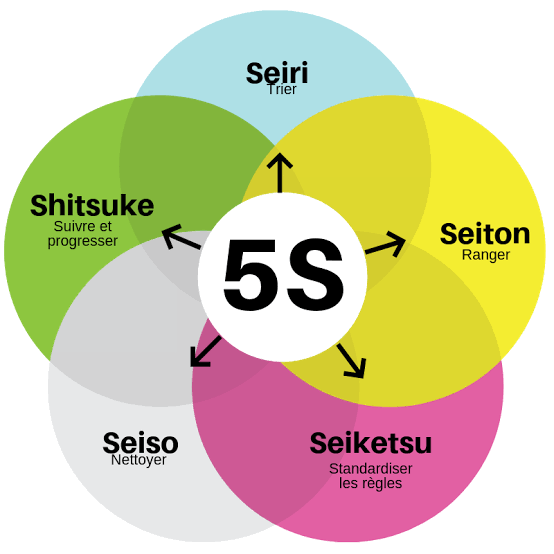
Answer: Sorting and removing what is unnecessary. Seiri (sort), Seiton (set in order), Seiso (shine), Seiketsu (standardise), Shitsuke (sustain). You start by throwing things out: there is no point neatly storing what is useless.
Answer: Tolerances come from customer needs; control limits come from how the process actually behaves. Confusing the two is a classic mistake. A process can be stable but incapable (it varies little, yet still falls outside tolerance), or capable but unstable. The two issues are handled differently.
Answer: Drastically reducing changeover time. Developed by Shigeo Shingo, the method aims for tool changes in under ten minutes by preparing in advance everything that can be done while the machine is running. Quick changeovers make it possible to produce in small batches without large stocks.
Answer: That the real root cause has not been found. Actions that do not last often treat a symptom. Go back to the facts, check that the assumed cause really reproduces the defect, and that removing it makes the defect disappear: that proof is what is most often missing.
33 more questions are waiting for you in the quiz!