🇫🇷 Version française · 🇪🇸 Español
🎃 Halloween special: play the Halloween quiz →
🎄 Christmas special: play the Christmas quiz →
🎆 New Year special: play the New Year quiz →
Free Productivity quiz: 70 trivia questions and answers — Pomodoro, Eisenhower & GTD. Easy to hard, with explained answers. No sign-up.
Start this quiz →🖨️ Printable version (20 questions + answers)
From the Japanese Kanban system to the SWOT matrix, this quiz explores the methods and tools that have become essential in project and business management. A fun way to test your management knowledge.
This quiz currently has 70 questions, ranging from easy to hard, available in French, English and Spanish when the Spanish translation is available.
Warm up before the quiz with these 14 trivia questions and their explained answers: click a question to reveal the answer.
Answer: Trello. A tool based on the Kanban method, ideal for tracking task progress in a team or solo.
Answer: FOMO. 'Fear Of Missing Out' is a modern phenomenon linked to social media.
Answer: Do it right away. The 2-minute rule in the GTD method encourages immediate action for small tasks.
Answer: Reduce stress and improve concentration. Mindfulness helps you stay focused and calm in a busy environment.
Answer: Time Blocking. Popularised notably by Cal Newport, Time Blocking consists of assigning each task a fixed slot in your calendar, reducing interruptions and distraction.
Answer: Tony Buzan. They imitate the way the brain links ideas, with branches, colours and images. They are as useful for revising as for preparing a meeting.
Answer: Sort, set in order, shine, standardise, sustain. Seiri, Seiton, Seiso, Seiketsu, Shitsuke: the method, from Toyota, rests on a simple principle: a clean, tidy workstation saves time and reduces errors and accidents.
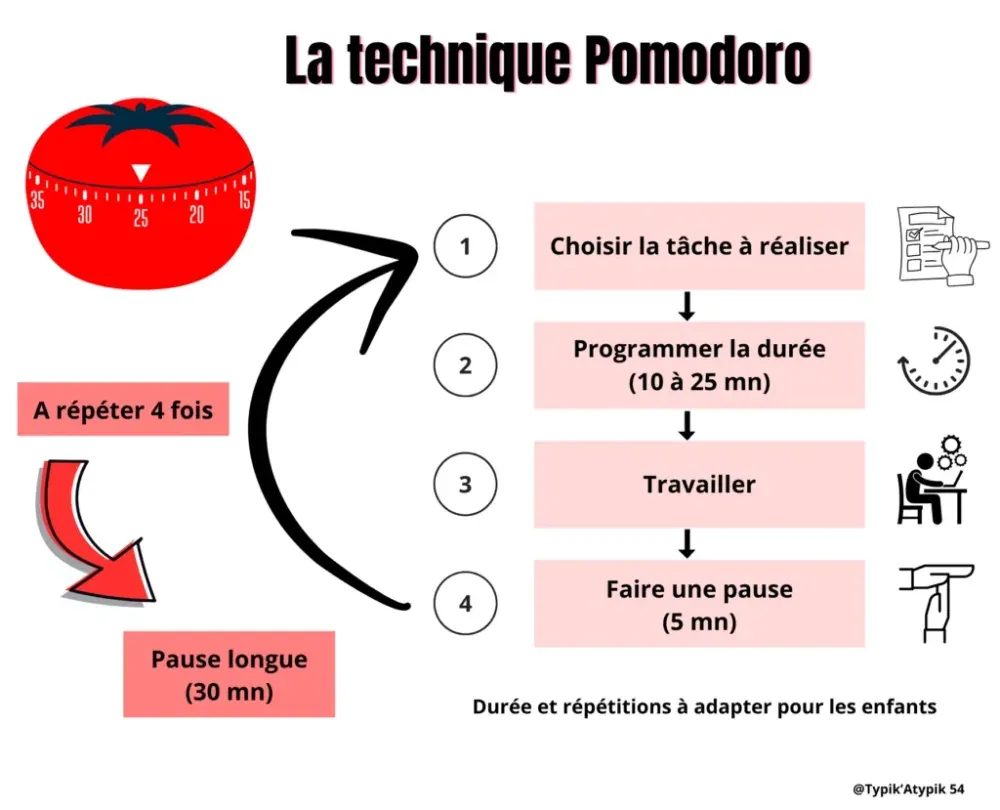
Answer: The Pomodoro Technique. Invented by Francesco Cirillo in the 1980s, this method improves concentration by dividing work into short intervals.
Answer: Stephen R. Covey. A foundational book in personal development, focused on effectiveness and ethical principles.
Answer: Minimum Viable Test. An experimental approach to find what works best with the least effort.
Answer: Kanban method. Kanban is a visual system using cards. Originally used to manage production flows and stock replenishment, it is now also used to visualise task progress and limit work in progress.
Answer: MoSCoW method. The MoSCoW method is widely used in agile project management to rank needs according to whether they are essential, desirable, possible or excluded from scope.
Answer: The Hawthorne effect. It is named after an American factory where, in the 1920s-30s, productivity rose whatever lighting change was tested: workers were mainly responding to the attention they received.
Answer: Takes less time and energy than if done in several sittings. Each interruption requires time to get going again. Hence the value of phone- and notification-free slots for tasks that need concentration.
56 more questions are waiting for you in the quiz!