🇫🇷 Version française · 🇪🇸 Español
🎃 Halloween special: play the Halloween quiz →
🎄 Christmas special: play the Christmas quiz →
🎆 New Year special: play the New Year quiz →
Fort and castle quiz: Fort Boyard, Vauban, Carcassonne, machicolations and drawbridges. Free trivia questions with answers, no sign-up.
Start this quiz →🖨️ Printable version (20 questions + answers)
From Fort Boyard to Fort de Brégançon, this quiz explores the history of the most iconic forts and fortifications. A fun way to test your heritage knowledge. This fort quiz covers sea forts, castles and Vauban's fortifications, with an explained answer for every question.
This quiz currently has 90 questions, ranging from easy to hard, available in French, English and Spanish when the Spanish translation is available.
Warm up before the quiz with these 18 trivia questions and their explained answers: click a question to reveal the answer.
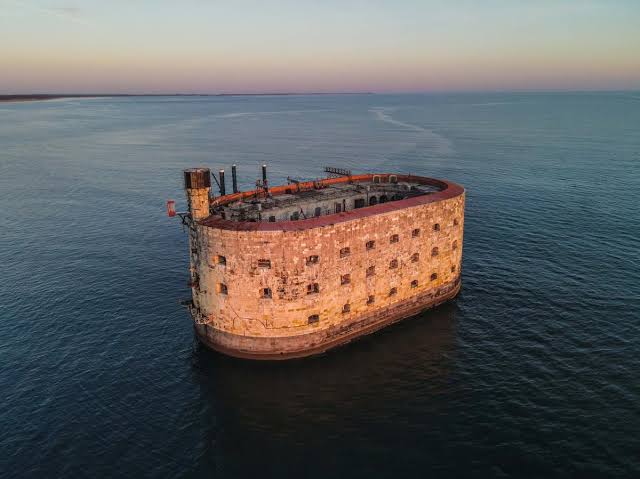
Answer: Atlantic Ocean. Fort Boyard is located in the Pertuis d'Antioche strait, between the Île d'Aix and the Île d'Oléron, in Charente-Maritime. Construction began in 1801, but its slow progress proved fatal as by the 1860s it had become obsolete for two reasons: advances in artillery eliminated the defensive gap it was built to fill.
Answer: The summer residence of French presidents. Fort de Brégançon is an official residence located on a peninsula in the Var, used by the Presidents of the French Republic. The Ligurians likely built a first oppidum there around the late 6th century BC.
Answer: Citadel of Calvi. Thanks to its strategic position and fortifications, Calvi was once considered an impregnable stronghold.
Answer: The Gulf of Morbihan. Defensive structures on several islands of the gulf mark Breton history.
Answer: To eliminate blind spots and better resist projectiles and undermining. The circular form deflects cannonballs more effectively and makes undermining (digging under foundations) much harder for attackers.
Answer: To control access and protect the main gate in case of attack. It allowed the passage into the castle to be cut instantly in case of danger.
Answer: Wood. Motte-and-bailey castles were built of wood on an artificial earthen mound.
Answer: Because of the development of gunpowder artillery. Vertical walls could no longer withstand cannonballs, making it necessary to switch to low, bastioned fortifications.
Answer: The alternating low and high sections allowing defenders to shelter while shooting. The merlon is the solid, raised part of the parapet, and the crenel is the gap between two merlons: defenders sheltered behind the merlon, then fired through the crenel.
Answer: Fort La Latte. Fort La Latte, also known as Château de la Roche Goyon, is a medieval fortification on a rocky headland facing the sea in Côtes-d'Armor. Its naturally inaccessible location and commanding views over the English Channel made it ideal for defence.
Answer: Verdun. Fort Douaumont was the largest and tallest structure of the Verdun fortress during World War I.
Answer: Antibes. Fort Carré is a four-pointed star-shaped fortification overlooking the port of Antibes.
Answer: Toulon. Fort de l'Éguillette is a historic fortification in La Seyne-sur-Mer, protecting the roadstead of Toulon.
Answer: Fort de Bertheaume. Fort de Bertheaume is located on an islet accessible by a footbridge in Plougonvelin, protecting access to the Brest harbor entrance.
Answer: All of the above. Langres was a major stronghold, with a town wall and numerous outlying forts. Its ramparts form one of the largest fortified enclosures in Europe.
Answer: Reims. Fort de la Pompelle was a crucial strongpoint preventing the Germans from taking Reims during World War I.
Answer: Its romantic restoration by Viollet-le-Duc. Napoleon III commissioned Viollet-le-Duc to rebuild this castle into an idealized and majestic version of a medieval castle.
Answer: Château de Saumur. The Château de Saumur is a medieval fortress transformed into a royal residence, overlooking the Loire.
72 more questions are waiting for you in the quiz!