🇫🇷 Version française · 🇪🇸 Español
🎃 Halloween special: play the Halloween quiz →
🎄 Christmas special: play the Christmas quiz →
🎆 New Year special: play the New Year quiz →
Free Minerals quiz: 79 trivia questions and answers — gemstones & crystals. Easy to hard, with explained answers. No sign-up.
Start this quiz →🖨️ Printable version (20 questions + answers)
From obsidian to the piezoelectricity of quartz, this quiz explores the fascinating properties of minerals and crystals. A fun way to test your geology knowledge.
This quiz currently has 79 questions, ranging from easy to hard, available in French, English and Spanish when the Spanish translation is available.
Warm up before the quiz with these 15 trivia questions and their explained answers: click a question to reveal the answer.
Answer: Diamond. Although it shares exactly the same chemical composition as pencil graphite (carbon), its ultra-compact three-dimensional crystal structure gives it an absolute hardness of 10 on the Mohs scale.
Answer: Emerald. Emeralds are tinted by traces of chromium and vanadium. Their internal inclusions (the 'garden') do not diminish their value; on the contrary, they attest to their natural origin and turbulent geological history.
Answer: They generate an electrical impulse. Discovered by Pierre and Jacques Curie, the piezoelectricity of quartz works in both directions: compressed, it produces electricity; subjected to a current, it oscillates at an ultra-precise frequency. This is the basis of our modern watches.
Answer: Plutonic rock. Plutonic rocks (such as granite) form by the slow cooling of magma deep underground, allowing mineral crystallization.
Answer: Pumice. After some underwater eruptions, real rafts of pumice drift on the ocean for months. In the bathroom, it is used to soften the skin on your feet.
Answer: Kaolin. Its name comes from Gaoling, a Chinese hill where it was mined. Its discovery at Saint-Yrieix-la-Perche made the fortune of Limoges porcelain.
Answer: 75%. For gold, the carat measures purity out of 24: 18 carats = 18/24 = 75% gold, the rest being other metals that make it harder. Nothing to do with the carat weight of gems (0.2 g).
Answer: Agate. It forms in cavities in volcanic rock, where silica is deposited layer after layer. Every slice is unique.
Answer: The Mohs scale. Created in 1812 by German mineralogist Friedrich Mohs, this scale ranks minerals from the softest (talc, rated 1) to the hardest (diamond, rated 10). Each mineral can scratch those with an equal or lower rating.
Answer: Quartz. Composed of silicon dioxide (SiO₂), quartz is extremely common and resistant. Pure, it is transparent (rock crystal), but traces of irradiation or chemical elements give it violet hues (amethyst) or yellow ones (citrine).
Answer: Lapis-lazuli. Lapis-lazuli is not a single mineral but a rock composed mainly of lazurite (blue) and pyrite (gold). During the Renaissance, it was ground to obtain the precious 'ultramarine' pigment, more expensive than gold.
Answer: Fluorite (or Fluorspar). Fluorite (CaF₂) is the reference mineral for hardness 4. It sports magnificent purple, green, yellow or blue hues caused by minor structural defects called colour centres.
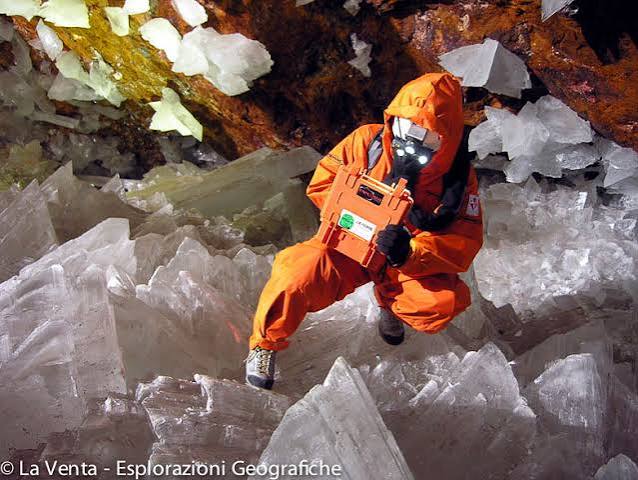
Answer: The Crystal Cave of Naica. Located 300 metres underground, the Naica cave housed perfect conditions: stable thermal water at 58°C saturated with minerals for 500,000 years. A geologically paradise — but mortally hot for humans (humidity close to 100%).
Answer: Iron and nickel. Once cut and polished, they reveal beautiful criss-cross patterns, called Widmanstätten patterns, which only form by cooling over millions of years in space.
Answer: Alexandrite. Discovered in the Urals in the 1830s, it is named after the future Tsar Alexander II. Its colours matched those of the Imperial Russian army.
64 more questions are waiting for you in the quiz!